
Categories
News

Malaysia to Remove Egg Subsidy by August 1

What’s happening

The Malaysian government will fully discontinue its egg subsidy program starting August 1, 2025, ending long-standing price support measures for consumers and producers.

Why it matters

Eggs are a staple in Malaysian households, and the removal of subsidies could impact consumer prices and household food security—particularly among lower-income groups. The move signals the government’s confidence in a stabilised supply chain and production cost environment.

Details
  • Effective May 1, the current subsidy of RM0.10 per egg will be halved to RM0.05.
  • All price controls on eggs will be lifted in August.
  • The decision was made following improvements in production stability and cost management within the egg industry.
What they’re saying

“The industry has shown consistent supply and competitive pricing, especially during the recent Hari Raya Aidilfitri festive season,” said the Ministry of Agriculture and Food Security (KPKM) in a statement.
They added that the industry is committed to introducing special-grade eggs at affordable prices to offset market changes.

Between the lines

While the government steps back from direct price intervention, it plans to soften the impact by:

  • Expanding affordable access through initiatives like Agro Madani and Rahmah Sales, available at FAMA and LPP outlets nationwide.
  • Enhancing enforcement against profiteering and price manipulation via the Price Control and Anti-Profiteering Act 2011 (Akhap 2011).
What’s next

As August nears, the focus will shift to monitoring retail egg prices, ensuring consumer protection, and watching how the market adapts to the removal of subsidies.
Categories
News

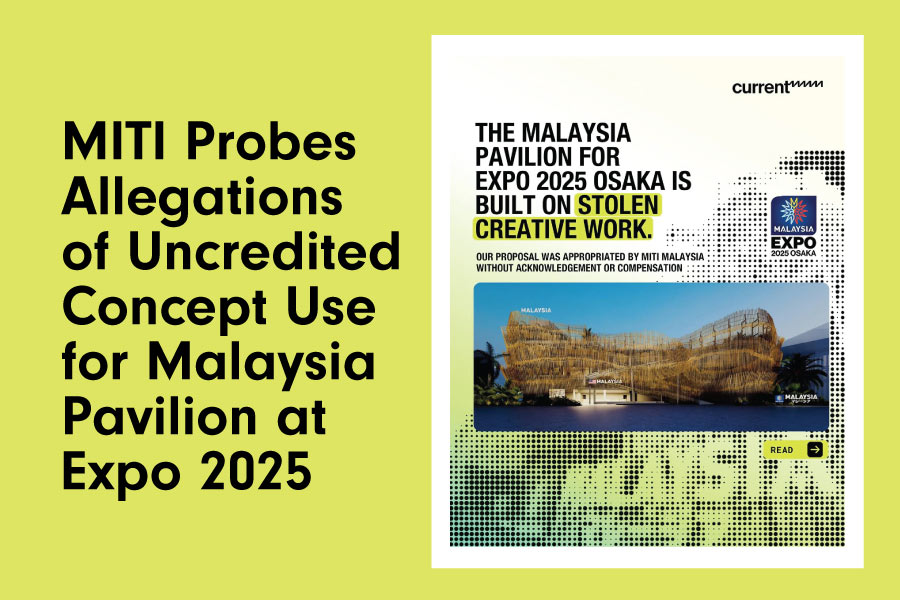
MITI Probes Allegations of Uncredited Concept Use for Malaysia Pavilion at Expo 2025

The Ministry of Investment, Trade and Industry (MITI) confirmed it is investigating claims circulating on social media alleging unauthorized use of a creative agency’s concept for the Malaysia Pavilion at Expo 2025 in Osaka, Japan, without appropriate credit or compensation.

These claims gained widespread attention following a viral Instagram post by user Fey Ilyas, prompting MITI’s swift response.

“MITI is currently undertaking a detailed investigation to gather and verify all pertinent facts concerning the allegations shared on social media,” the ministry stated briefly.

“We regard this matter with utmost seriousness and reserve all legal rights. MITI remains dedicated to maintaining the highest standards of integrity and compliance. We will take necessary legal actions if warranted,” the statement continued.

Although MITI did not explicitly name any individual or agency, Fey’s widely shared Instagram post—under the username @feythehuman—directly accused the government of adopting the agency’s concept, theme, narrative, and architectural vision for the Malaysia Pavilion without giving due credit or remuneration.

In his post, Fey detailed the substantial effort by his agency, stating they had “helped secure approvals, brought in world-class partners, and shaped the foundation” for Malaysia’s significant presence at the global expo.

“As a small company, even receiving proper acknowledgement for a project of this scale would have helped us build our reputation and open doors to new opportunities. Instead, our work was taken — used without credit or compensation,” Fey wrote.

He further alleged his agency faced pressure to remain silent, with implications that speaking out could jeopardize future business prospects.

“But what’s the point of future work if it’s built on silence, exploitation, and fear?,” Fey questioned. “We chose to speak up. Because dignity is worth more than access.”

Categories
News

Ayer Kuning By-Election: A Crucial Test for Malaysia’s Political Landscape​

The upcoming by-election in Ayer Kuning, Perak, scheduled for April 26, 2025, has garnered significant attention as it could influence the political dynamics within the state and potentially at the national level.​

Background

The by-election was necessitated by the untimely passing of incumbent assemblyman Ishsam Shahruddin of Barisan Nasional (BN) on February 22, 2025. Ishsam had secured the seat in the 2022 state elections with a majority of 2,213 votes.

Candidates

The by-election features a three-cornered contest:​

  • Dr. Mohamad Yusri Bakir (BN – UMNO): An Islamic education academic and Tapah UMNO Secretary. He aims to continue Ishsam’s legacy, focusing on educational development. ​
  • Abdul Muhaimin Malek (PN – PAS): The Tapah PAS chairman, representing Perikatan Nasional. His candidacy reflects PN’s strategy to strengthen its presence in Perak. ​
  • Bawani Kaniapan (PSM): A lawyer and PSM’s national deputy secretary-general. She previously contested the seat in 2022 and is backed by MUDA and PRM.
Campaign Highlights

The campaign period has been marked by several notable events:​

  • High Early Voter Turnout: Early voting on April 22 saw a turnout of 93.4% among police personnel and their spouses, indicating strong voter engagement. 
  • Asset Declaration Debate: While Bawani publicly declared her assets to promote transparency, Dr. Yusri declined to do so, stating he had already fulfilled necessary declarations upon his retirement from public service. 
  • Allegations of Misuse of Government Resources: Electoral reform group Bersih raised concerns over alleged abuses, including the use of government machinery and facilities during the campaign. ​
Demographics and Significance

The Ayer Kuning constituency comprises 31,897 registered voters, with a demographic breakdown of approximately 55.6% Malay, 22% Chinese, 14.3% Indian, and 8.1% others. ​

The by-election is viewed as a litmus test for the unity government formed by BN and Pakatan Harapan (PH), especially in gauging public support ahead of the next general election.​

Looking Ahead

As polling day approaches, all eyes are on Ayer Kuning to see which candidate will emerge victorious and what the results will signify for Malaysia’s evolving political landscape.​

Categories
News

U.S. Imposes 24% Tariff on Malaysian Imports Amid Global Trade Measures

Driving the news

On April 2, 2025, U.S. President Donald Trump announced a series of “reciprocal” tariffs targeting numerous countries, including a 24% tariff on Malaysian imports, effective April 9. This action is part of a broader strategy to address trade imbalances and protect domestic industries.

Why it matters

The newly imposed tariffs are poised to significantly impact Malaysia’s export-driven economy, particularly sectors heavily reliant on the U.S. market. Industries such as electronics, machinery, and medical devices may face increased costs and reduced competitiveness.

The big picture
  • Tariff Justification: The U.S. administration asserts that these tariffs are necessary to counteract what it perceives as unfair trade practices and to promote equitable trade relationships. ​
  • Global Scope: Malaysia is among several nations affected by these measures. Notably, China faces a 34% tariff, the European Union 20%, and Vietnam 46%.
  • Economic Implications: Analysts warn that such tariffs could disrupt global supply chains, elevate consumer prices, and potentially trigger retaliatory actions from affected countries. ​
Between the lines

The U.S. claims that Malaysia imposes a 47% tariff on American goods, justifying the 24% reciprocal tariff. This move underscores the administration’s focus on addressing perceived disparities in international trade policies. ​

What’s next

The Malaysian government and business community are expected to engage in discussions to assess the impact of these tariffs and explore potential responses. The situation remains fluid, with the possibility of negotiations or countermeasures in the coming weeks.​